Your agents, finally in one room.

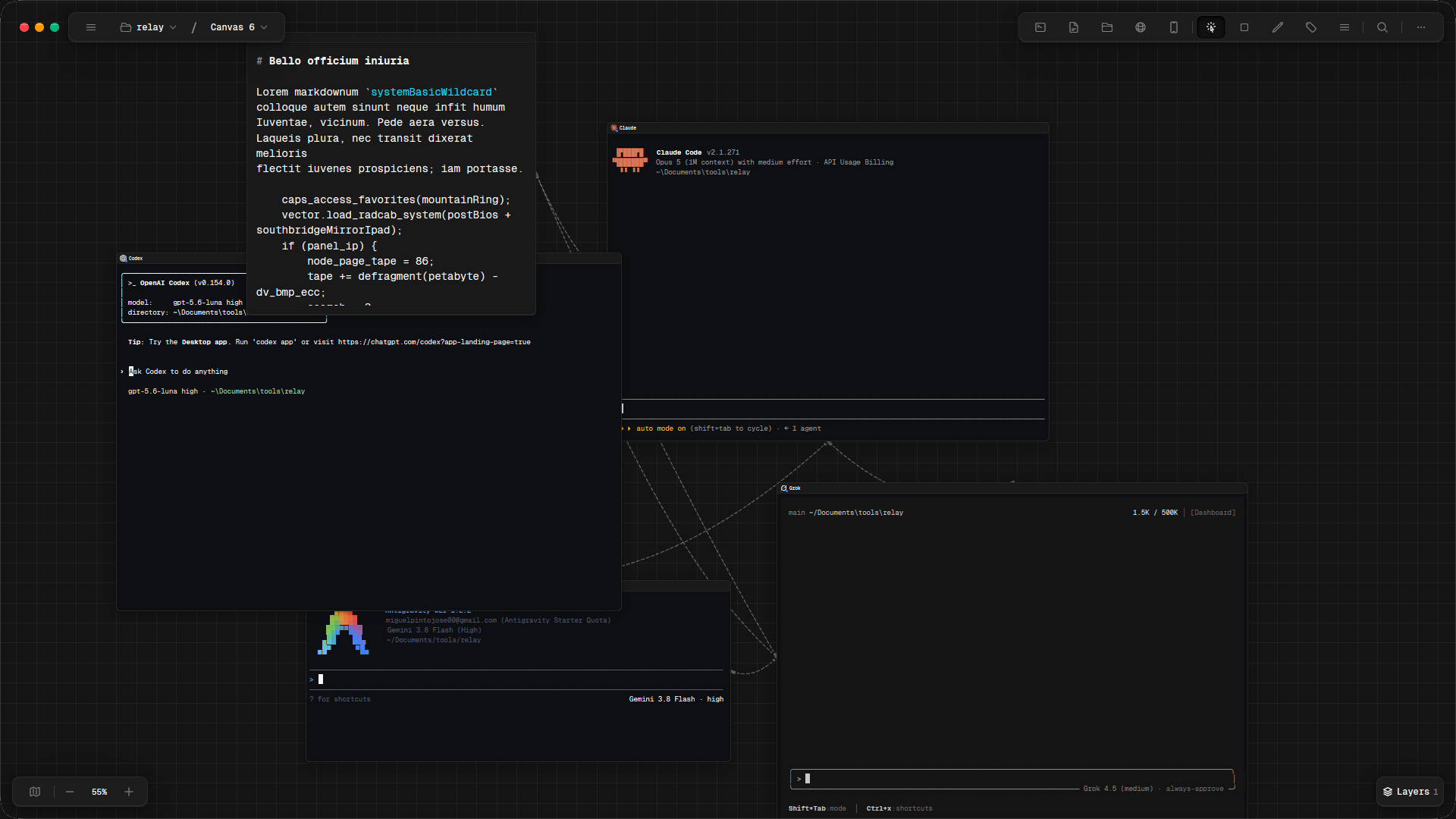
Claude Code, Codex, Grok and your shell as live terminals on one canvas. Wire them together, hand off work, and see who's stuck. No more twelve tabs.

Relay canvas with several agent terminals running side by side

Twelve agents. One glance.

Every agent runs in plain sight
Each node is the real CLI in a real terminal, on its own login. Green is working, amber is waiting, and you never hunt for the right tab again.

4agents running

The one that needs you finds you

When an agent stops, fails or rings for you, it lands in one queue. Press Tab and you're on the node.

Codex 2 · waiting for youTake me thereTabLater

A wire is a permission.

Draw a line between two agents and they can hand each other work. No wire, no access. Every task gets an ID and a result, and survives a restart.

Agents that check their own work.

Put a real browser or an Android phone on the canvas, wire it to an agent, and let it click through what it just built.

Browser portals. A live Chromium page as a node. The agent wired to it navigates, clicks, fills forms, reads the page and takes screenshots.

Device portals. An Android emulator or your own phone, driven the same way: tap, swipe, type, and read logcat.

Parallel branches. Zero collisions.

Workspaces hold your projects. Every layer is a real git worktree on its own branch, so agents on different layers never touch the same files.

Workspaces hold your projects. Folders group canvases, and every canvas is one repository, opened right where it lives. Or on a Linux server, over SSH.

SelectTerminalNoteFilesPortalDeviceRectangleLabelTextDrawPaletteMore

Every tool, one rail. Terminals, notes, file trees, portals and devices. Draw, label and search without leaving the canvas.

Layers are real branches. Spin up a worktree for the risky idea. Your agents keep shipping on the real one.

Built for a canvas with twelve agents on it.

Cross-canvas agents

Agents on other canvases answer to Name@canvas. Tasks cross over; screens and keyboards never do.

Tasks that survive restarts

Queued work outlives a crash and waits for the agent that isn't running yet.

Sessions that come back

Claude Code and Grok resume the exact session they left, node by node.

Prompt five at once

Select a few agents and type once. Attach any file or paste a screenshot.

Focus mode

One key zooms a node to fill the screen. The same key takes you back.

Saved views

Nine camera bookmarks per canvas. Jump between them with Alt and a number.

Notes agents write to

Markdown notes an agent can read and append to, only when you wire it in.

Arrangements

Save a team of nodes and wires as a template. Stamp it on any canvas.

Files and Git

File trees, an editor with autosave, and per-file staging and diffs, on the canvas.

Every account. Every provider. Every role.

Questions, answered

Does Relay replace my terminal?

No. Every node is a real terminal running the CLI you already use, on your own login. Relay puts them on one canvas and wires them together.

Which agents work with it?

Claude Code, Codex, Grok, OpenCode and Antigravity out of the box, plus your shell and any custom command.

Is it a subscription?

No. $10, once, and it comes with a seat in the Discord. You can try it free for 7 days first.

What happens after the 7 days?

Relay locks until you enter a license key. Your workspaces stay on your disk. The trial belongs to the computer, so reinstalling does not start a new one.

How do agents talk to each other?

Through the wires you draw. A connected agent can ask, delegate and hand results back. An agent with no wire can't reach anyone.

Does my code leave the machine?

No. Workspaces are local JSON and Markdown, each agent keeps its own provider login, and there's no telemetry unless you opt in.

Which platforms?

macOS on Apple silicon and Intel, Windows x86_64, and Linux x86_64 on Wayland or X11.